Choosing the Right Rack Vendor: 5 Questions Every Engineer Should Ask

Choosing a rack enclosure involves more than selecting the lowest bid. In defense, data centers and industrial manufacturing, a rack is a critical system with strict requirements that go well beyond the hardware. The vendor behind the rack matters as much as the rack itself.
The wrong vendor choice is not always obvious at first. Problems tend to surface later in the form of designs that do not fit, specs that are not met or projects that stall because the vendor could not deliver. At that point, fixing the problem is expensive and time-consuming.
Asking the right questions up front is the best way to avoid those risks. Knowing what to ask helps to provide clarity on which supplier can support your organizational needs. Here’s our guide to choosing the right vendor.
The Importance of Choosing the Right Rack Vendor
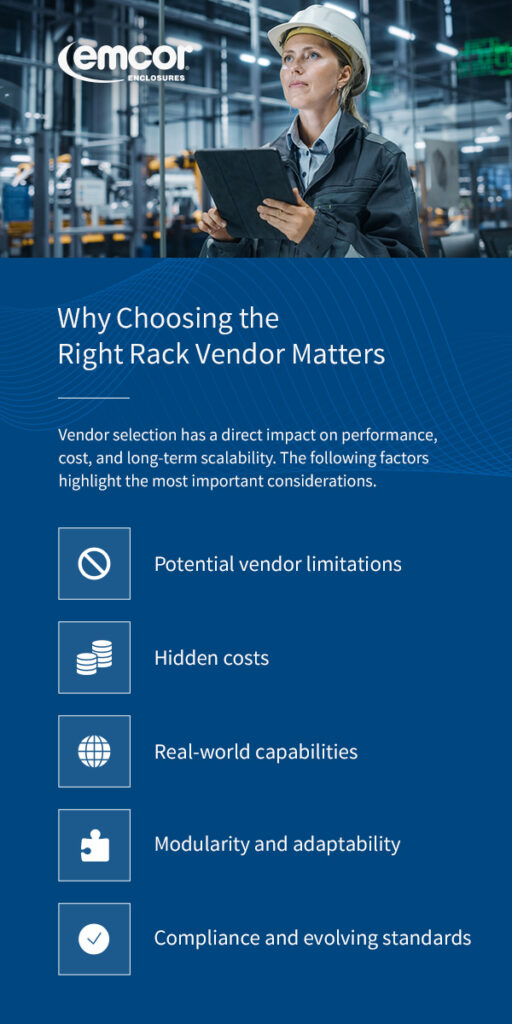
Vendor selection affects every stage of a rack deployment. The following factors explain why the decision is more important than it may initially appear.
- Potential vendor limitations: The limitations of a chosen vendor are not always apparent at first. The most critical limitations typically surface late, like during installation, audits, expansion or modification. Choosing the right rack supplier or vendor at the start reduces problems later.
- Hidden costs: A poor vendor fit can lead to hidden costs to fix unforeseen complications. For example, data center rack vendors that cannot accommodate your needs can cause life cycle inefficiencies and engineering rework. Other industries can experience missed deadlines or complete redesigns if the wrong vendor is chosen.
- Real-world capabilities: Vendor capability determines how a rack performs in real-world conditions. Engineers must understand the factors that determine successful performance. The right vendor choice helps you look beyond a spec sheet.
- Modularity and adaptability: Most deployments have unique requirements that standard catalog products cannot fully address. A vendor with in-house modular capabilities can adapt a rack to meet exact project specifications. This flexibility reduces the need for costly workarounds and keeps projects on schedule.
- Compliance and evolving standards: Key decision-makers navigating highly regulated sectors cannot underestimate compliance. A capable vendor has critical expertise in meeting industry compliance and evolving standards.
The right vendor acts as a technical partner, not just a rack enclosure manufacturer. Narrowing down your specific requirements helps deepen your search.
5 Questions to Ask a Prospective Rack Supplier
Engineers have a lot at stake in choosing the right rack vendor. It is important to ask specific questions to help determine how well-suited the vendor is for your needs. Below are the five questions every engineer should ask a potential vendor.
1. Are Your Racks Truly Customizable?
Many vendors advertise custom rack solutions. On closer inspection, most will only offer minor modifications to standard SKUs. Engineers and senior decision-makers should probe further in their line of questioning about potential custom enclosure manufacturers. Remove any doubt of what a vendor’s capacity for customization will be through direct questions, like:
- Can dimensions, venting, cutouts and mountings be fully customized?
- Are changes engineered in-house or outsourced?
These questions can help solidify a vendor’s capabilities. Real deployments will not always fit catalog expectations. Reputable custom enclosure manufacturers should have clear answers to reduce downstream compromises. Asking about a vendor’s custom electronics capabilities tells you a great deal about their in-house engineering and manufacturing processes.
2. What Are Your Real Lead Times and What Controls Them?
A quoted lead time will not always be an accurate timeline. An initial quote can ignore aspects like outsourced fabrication, material sourcing and finishing bottlenecks. Vendors may be overly optimistic and project timelines that can lead to significant delays and unforeseen costs. Engineers should explore further details by asking about which steps are performed internally versus externally, and how lead times may be affected by design changes.
A vendor with control over each stage of the manufacturing process domestically can offer predictable timelines. Fewer external dependencies mean greater supply chain transparency and stronger internal controls. A vendor’s answer can inform how delays could eventually cascade into commissioning and customer commitments.
Many rack manufacturers and server rack suppliers will outsource parts of their process. This process can add new complexities to a project’s timeline that a primary vendor cannot solve. Engineers who understand a project’s actual lead times can secure reliable timelines without risking excessive budgets.
3. What Engineering and Manufacturing Standards Do Your Racks Meet?
Compliance claims are common. Verification of that compliance is not. Rack compliance standards may vary depending on the specialism or industry. However, nothing should be left to assumption. Explicitly asking vendors for confirmation of which standards they build to is crucial.
Finding engineering-led compliance in a vendor can ensure adherence during the design and fabrication process. Before making a final decision, engineers should consider the following standards:
- Electronic Industries Alliance Standard 310: This standard confirms the rack’s mounting geometry (opening and hole spacing) conforms to the standard 19-inch rack format, helping ensure rackmount equipment fits as expected. Noncompliance can cause installation delays, replacements and custom modification costs.
- Open Compute Project (OCP) specifications: OCP publishes open specifications, such as the Open Rack (e.g. ORv3), which define interoperable rack and power-system components commonly used in hyperscale environments. While OCP is not a standards body, a data center rack vendor with OCP specifications in place shows a forward-thinking mindset.
- Seismic standards: Compliance requirements in seismic zones help prevent rack infrastructure collapse. They also protect critical assets and equipment. Standards typically include Telcordia GR-63-CORE, the International Building Code, and the ASCE 7 standard.
- EMI/EMC standards: Electromagnetic interference (EMI) and electromagnetic compatibility (EMC) standards support system reliability and data integrity. Common standards include the IEC 61000 series, FCC Part 15 and CISPR. These standards are integral for rack and equipment safety from data corruption, operational failure and external interference.
- Other industry-specific standards: The typical industry-specific standards, including NEMA and MIL-SPEC, and legally mandated standards like FCC regulations, are also crucial.
4. Do You Offer Engineering Support Before and After Delivery?
Vendor support often ends at shipment. But pre- and post-delivery collaboration ensures a rack design meets all technical and integration requirements. Vendors that are open to working with engineers show an understanding of customer needs and efficiency. Having the ability to optimize for power distribution, cable routing, thermal management and future scalability can secure long-term value beyond the purchase price.
Support should also come in other areas. A good vendor will have years of insights and specialized knowledge, highlighting design flaws and suggesting solutions that are clear and easy to explain to stakeholders when justifying spending decisions.
Post-delivery support for integration or modification is essential for smooth deployment. All systems can encounter challenges and unexpected issues when integrating into infrastructure. Having access to support keeps your racking investment agile and operational. It reduces potential downtime, helping maintain project timelines and operational continuity.
A vendor with a long-term partnership mindset for design is important. It shows a willingness to adapt to your needs rather than simply fulfilling a transaction.
5. How Do You Control Product Quality During Manufacturing?
Vendors may succeed at prototypes but struggle at production scale. An excellent prototype doesn’t always guarantee consistency in mass production.
Challenging a vendor on their ability to scale can tell you a lot about their quality control. What changes as quantities increase? Questions like this are essential for many reasons, including:
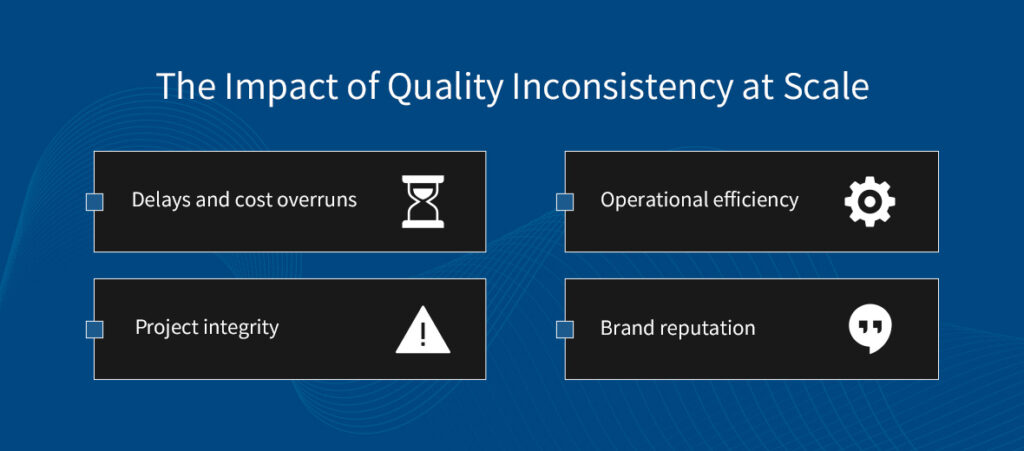
- Delays and cost overruns: Inconsistency at scale leads to rejected shipments, expensive delays and cost overruns. Industries that rely on server rack suppliers for support cannot risk inconsistencies in sample and volume orders.
- Project integrity: Mission-critical applications can be impacted by the smallest of quality variations. In data centers and defense sectors, these issues have a direct impact on project integrity.
- Operational efficiency: Reduced quality across a large deployment increases maintenance hours. Engineering managers are then tasked with troubleshooting complex issues that affect operational efficiency.
- Brand reputation: Inconsistency and poor quality can cause irreparable damage to all organizations involved, from decision-makers to vendors and system integrators.
It is also important to ask about how tolerances, weld quality and finishes are controlled at volume. The answer will highlight how a vendor ensures structural integrity and longevity, as well as what measures they take to protect against corrosion. It also tells technical buyers and engineers whether the vendor’s processes and quality control can accommodate their needs.
Warning Signs to Watch for When Selecting a Rack Supplier
Any uncertainties in a potential vendor should be resolved before making a decision. Red flags can arise as engineers ask questions. Each can signify potential problems that can undermine a project, compromise performance and increase budgets.
- Vague answers about customization limits suggest a lack of complex customization, or a refusal to invest in it. Standardized solutions are rarely a good fit for defense or industrial applications. Ambiguity also hints at limitations later on in the design process. A good vendor should clearly express capabilities and limitations.
- Overreliance on overseas or multi-vendor fabrication may appear cost-effective on paper. But multi-vendor supply chains can create significant issues for sensitive projects. When procurement is spread across multiple vendors, accountability for delays becomes difficult to establish.
- Vague responses to compliance questions indicate the vendor has likely never been tested in a regulatory environment. A quality vendor will have clear compliance adherence from the beginning.
- One-size-fits-all rack platforms tend to deliver generic results. A generic platform is also likely to lead to wasted space, poor airflow and higher future costs. It hints at a vendor more concerned with manufacturing simplicity than with customer needs.
- Support teams disconnected from engineering or manufacturing cause obstacles between design and production. A cohesive feedback loop that includes engineering, manufacturing and support protects your investment. Streamlining communication between experts reduces downtime.
The Benefits of a Strong Vendor Relationship
A strong vendor relationship is built on a clear supply chain strategy and open communication. Here is what engineers can expect from the right rack supplier:
- Clear documentation and drawings for precise planning and integration with existing infrastructure
- Welcoming early engineering involvement at the beginning of a project
- Transparent timelines focused on long-term success
- Decisions aligned with the necessary standards
- Responsive support during deployment and expansion
- The ability to collaborate effectively on custom rack solutions
- Predictable quality across every unit, from prototype to full production run
Integrating these factors into the decision-making process reduces the likelihood of problems.
Why Engineers Choose Emcor for Custom Rack Enclosures
When it comes to choosing a rack supplier, Emcor is a top partner for many engineers. Our range of services is built on collaboration, not immediately going to stock solutions. We support engineers who need to integrate several different electronics requirements into one neat footprint. Some of the main reasons engineers enjoy partnering with us include:
- Domestic, vertically integrated fabrication
- An engineering-first collaboration model
- Proven experience across demanding environments
- The ability to design for an application instead of around limitations
- Long-term reliability over short-term savings that lead to further issues
Our ability to modify our standard offerings to meet application needs sets us apart from suppliers who only offer one-size-fits-all solutions.
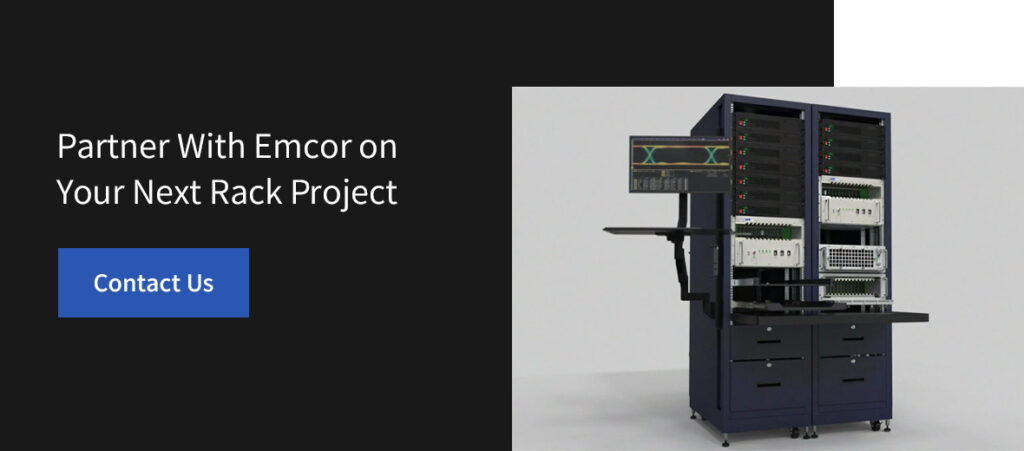
Partner With Emcor on Your Next Rack Project
Price always matters. However, costly risk, delays and reputational damage matter more. When choosing the right rack vendor, these five questions can uncover everything needed to make a final choice, reducing the engineering burden, project delays and life cycle costs.
Asking the right questions will uncover the ideal partners for achieving your specific needs. Emcor’s convenient STEP files allow engineers to drop models into their designs. We also support customers through live support and rapid response times, fostering a collaborative relationship.
Emcor remains a leader in the enclosure market, offering one of the largest selections of cages, cabinets, racks and enclosures. Do you have questions about what we can do for you? Contact us to schedule a vendor evaluation call, request a quote or review our design capabilities.