Measuring Performance: How Emcor’s Isolated Shock Pallet Reduces Impact Acceleration
Visualizing Shock Attenuation
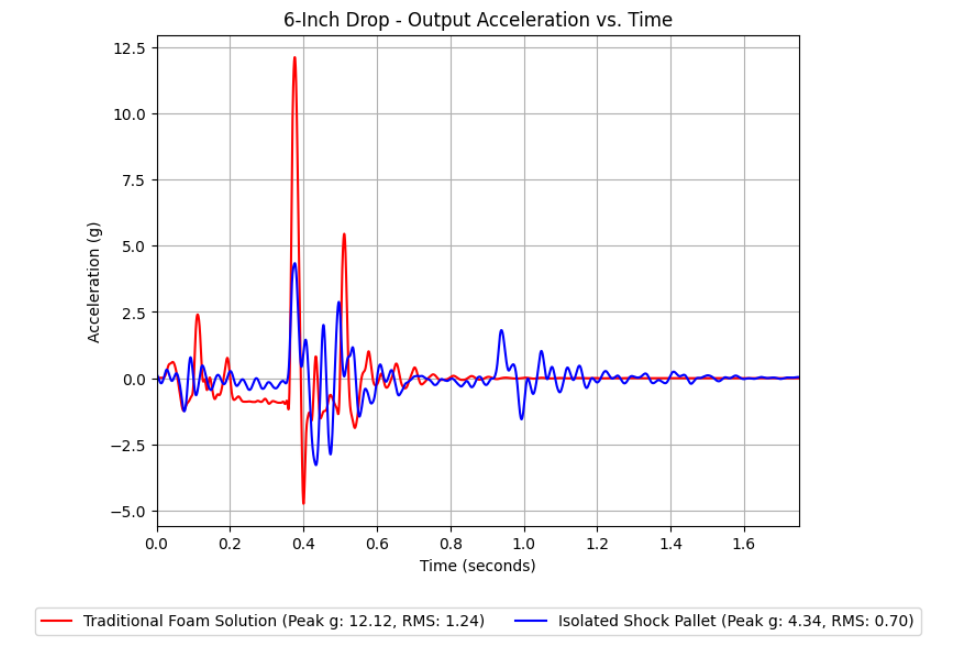
The chart above compares acceleration data recorded during a 6-inch drop test, contrasting a traditional foam-based solution (red) with Emcor’s isolated shock pallet (blue). Each curve represents how acceleration changes over time as the system absorbs impact energy. The foam system reached a peak acceleration of 12.12 g, while the isolated pallet limited the response to just 4.34 g, indicating a dramatic reduction in transmitted shock.
Understanding Output Acceleration
An Output Acceleration vs. Time plot reveals how a system reacts to vibration or impact. Sudden spikes represent shock events, while smoother oscillations indicate residual vibration. By visualizing these changes over milliseconds, engineers can evaluate how effectively a mounting system dissipates energy and protects sensitive equipment.
What RMS Acceleration Tells Us
RMS (Root Mean Square) acceleration quantifies the average energy of the vibration signal. The isolated pallet achieved a lower RMS of 0.70 g compared to 1.24 g from the foam solution, meaning it sustained far less vibrational energy. Lower RMS values correlate directly to improved stability and component longevity—key advantages in overland and defense applications.