Why ORV3 Compliance Alone Isn’t Enough: The Case for Engineered, North American-Built OCP Racks

Open Compute Project (OCP) racks are built around a standardized hardware specification called ORV3. The spec covers internal dimensional conformance, power architecture compatibility and interface standards. Most vendors can meet it. What the spec doesn’t tell you is how well a rack is engineered above those minimums or whether it will be delivered when needed.
Some vendors build to the minimum spec and stop there. Others go further, offering application-specific modifications without the cost or lead time of a full custom build.
This gap matters. Choosing the wrong vendor means you’re looking at performance issues, missed deadlines and costs that spiral fast. Data center, defense and industrial deployments have no margin for that kind of risk.
When Every Rack Vendor Looks the Same on Paper
When every vendor you’re evaluating is ORV3-compliant, the spec becomes less useful as a differentiator. Every spec sheet looks the same. It defines the minimum requirements. What a vendor does above those minimums is entirely their choice, at their cost.
Compliance confirms a rack was built to the minimum spec. It doesn’t confirm that the external dimensions will integrate cleanly with your existing infrastructure or whether it will ship on schedule. Two OCP rack manufacturers can both be ORV3-compliant and deliver very different results in the field.
Price quotes compound the problem. When three vendors are within 10% of each other on cost, offer similar lead times and claim compliance, the decision looks arbitrary. It’s not. Vendors who compete on price alone often cut corners on fabrication quality, engineering support or lead time predictability.
The real differentiators don’t show up in vendor quotes or product brochures. How a vendor approaches engineering, what their quality control actually looks like and whether their supply chain can handle disruptions are the questions that determine whether a deployment stays on schedule and performs as expected.
What ORV3 Compliance Actually Covers and What It Leaves Out
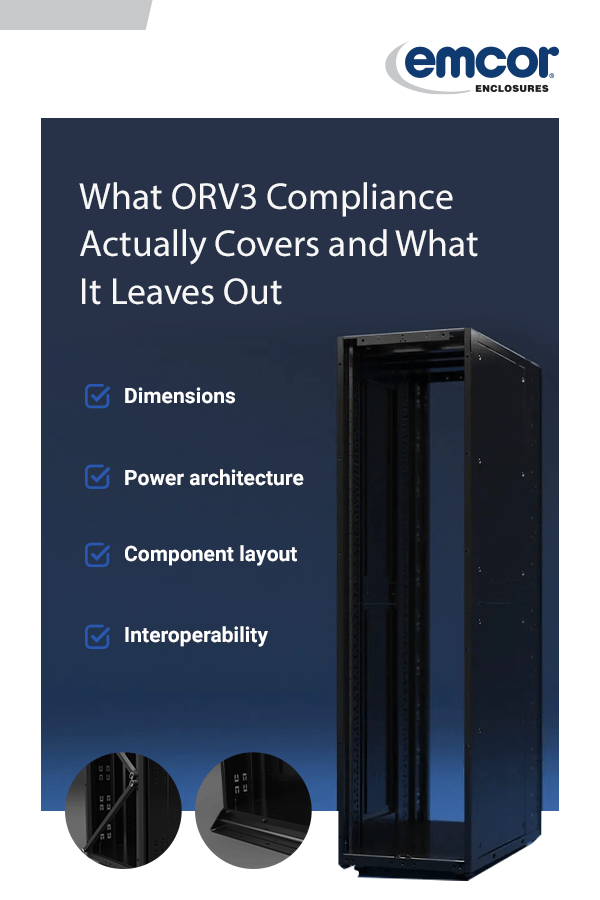
The ORV3 base specification tightly controls internal dimensions, power architecture and interface standards. It exists to ensure hardware from different manufacturers works together in the same deployment. The spec also covers operating and storage environments, environmental compliance requirements and testing standards. What falls outside its scope is how far above those minimums a manufacturer chooses to build.
These four categories show exactly what the spec covers and what it leaves to the manufacturer:
- Dimensions: ORV3 controls internal dimensions, so any ORV3-compatible hardware can fit inside any ORV3-compliant rack. External dimensions are not controlled, which means how racks integrate with each other or with existing infrastructure varies by manufacturer.
- Power architecture: The spec confirms 48-volt power architecture compatibility, but how power is routed, distributed and integrated within your specific system is entirely up to the manufacturer.
- Component layout: ORV3 establishes a baseline for any hardware that meets the spec. The spec permits modifications as long as critical features are not compromised. Any modification requirements should be clearly defined before the project begins.
- Interoperability: Standardized interfaces are required, providing buyers with a reliable foundation for integration. Whether your deployment comes together cleanly depends on how thoroughly you’ve evaluated your specific requirements before selecting a vendor.
Where Compliance Falls Short in Real Deployments
The spec controls internal dimensions. Material quality, external dimensions and assembly consistency above the minimum are left to the manufacturer. A rack built to the minimum can still clear every requirement in the spec.
The consequences show up fast. External dimension variance creates fitment problems when racks need to integrate with each other or with existing infrastructure. Inconsistent assembly across units means the first rack might install cleanly and the next one doesn’t. At scale, this variance becomes a serious problem.
Thermal management is a common failure point that compliance doesn’t address. A rack can meet every dimensional requirement and still create airflow bottlenecks if fabrication variances reduce the clearance between components or internal baffles are poorly positioned. The spec assumes maximum load is evenly distributed across each slot. Racks built only to that assumption can struggle under real loading conditions.
Cable routing tells a similar story. A compliant rack with inadequate cable management paths creates maintenance problems from day one and limits what you can add later. By the time these issues surface on the floor, switching vendors isn’t an option. The risk was locked in when you chose your vendor.
Evaluating Engineering Depth
Engineering depth determines whether a rack is designed around your actual deployment requirements or only built to spec. When you’re integrating specific hardware, managing thermal loads or planning for future expansion, that difference shows up quickly. How a manufacturer approaches engineering and design flexibility determines whether a rack performs well or simply meets the minimum requirement.
Spec Compliance vs. Application-Specific Performance
Most rack manufacturers build to the spec and stop there. An application-specific manufacturer goes further, designing around how your system actually needs to perform rather than just what the standard requires. For complex deployments, this distinction determines how smoothly everything comes together.
A manufacturer with genuine engineering depth asks about your hardware before quoting a price. They want to know your thermal profile, your power distribution strategy and your maintenance access requirements. Those answers drive design decisions that a standard off-the-shelf rack cannot accommodate.
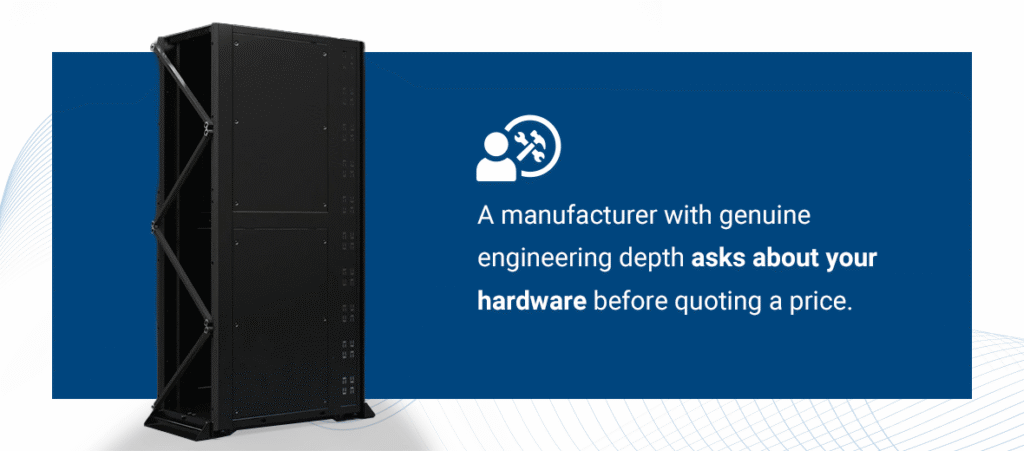
The practical difference shows up in the details. Load distribution, airflow alignment and power routing all affect how well your hardware performs once it’s installed. Vendors who aren’t asking those questions are designing a generic rack, not a solution for your deployment. The gap surfaces during deployment when integration problems emerge that a more thorough design process would have caught early.
A vendor that engineers for your deployment builds a rack tailored to how your system actually runs, not just one that complies with ORV3 standards.
The Role of Modularity and Standard-Modified Designs
Most buyers assume rack procurement is a choice between off-the-shelf and fully customized. Off-the-shelf designs ship fast but offer little flexibility for complex deployments. Fully custom builds offer exact specifications but come with higher costs and longer lead times.
Sheet metal fabrication opens a third option. A standard ORV3 design can be modified to meet application-specific requirements without the tooling costs or extended timelines required by a custom build. The modification happens at the design stage, before the rack ever ships.
The real challenge that engineers face isn’t finding a compliant rack. It’s packaging disparate electronics into a single footprint, often on a timeline that doesn’t allow for extended lead times. A standard-modified design addresses that problem without the cost or lead time of a full custom OCP rack.
If a specific modification is not listed in a manufacturer’s catalog, it’s worth asking whether they can build it. Many requirements that appear custom are well within the capabilities of an experienced sheet metal fabricator working from a standard ORV3 baseline.
Assessing Manufacturing Precision and ORV3 Rack Quality
Manufacturing precision determines whether a rack performs consistently across every unit in a deployment. A design can be engineered well and still fail in the field if the fabrication doesn’t hold tight tolerances. High-quality data center rack manufacturing comes down to how well those tolerances are maintained and verified across every unit produced.
Why Tight Tolerances Matter in High-Density Racks
When racks are loaded with high-density equipment, small fabrication variances compound quickly. A minor misalignment at the mounting rail that seems minor early in installation becomes a fitment problem as the rack fills up. Airflow paths get disrupted and structural stress concentrates in the wrong places.
Tight tolerances aren’t optional in high-density deployments. They determine whether a rack holds up throughout the full life cycle of a deployment or creates problems that worsen over time. A rack that passes acceptance testing can still create thermal and mounting problems once it’s fully loaded and running under real operating conditions.
Precision manufacturing ensures that every rack in a deployment performs consistently, not just the first unit installed. Tolerance issues can surface as racks fill up, particularly when heavy equipment creates uneven weight distribution across slots. When cooling starts to fall short or hardware doesn’t seat correctly, fabrication inconsistency is often the cause.
High-density environments leave no room for fabrication inconsistency. The more equipment you pack into a footprint, the more every millimeter matters.
From Fabrication Quality to Long-Term Reliability
ISO 9001 certification indicates whether a manufacturer has documented quality control procedures and consistently follows them. For procurement teams, it’s one of the few vendor claims that an independent auditor has actually verified.
Consistent fabrication means repeatable quality across every unit in a deployment. The first rack and the hundredth meet the same tolerances. That consistency matters even more when placing a second order months or years later. New racks need to integrate seamlessly with the existing units.
When a deployment calls for modifications, the requirements should be identified before the project begins. Modifications planned from the start are far less likely to create structural or fitment problems.
Poor quality control can also affect lead time. When units fail inspection, rework pushes delivery dates back and delays your installation schedule.
Analyzing Data Center Supply Chain Reliability and Deployment Risk
Supply chain reliability determines whether racks arrive when your project needs them. A well-engineered, precisely built rack can still delay your deployment if it doesn’t ship on schedule. Manufacturing location and sourcing decisions strongly affect whether that schedule holds.
The High Cost of Global Supply Chain Delays
Suppliers who source components and build racks overseas introduce uncertainty into your delivery timeline. Shipping delays, port congestion and holds at customs can push a quoted delivery window back by weeks with little warning. Since rack procurement is typically one of the last decisions in a deployment plan, it leaves no room for supply chain delays.
When a rack arrives late, the entire installation stalls. Servers sit in staging. Network equipment has nowhere to mount. Installation crews stand idle while facility costs and project milestones move to the right.
Supply chain disruptions and equipment shortages are delaying data center and defense projects nationwide. A vendor whose manufacturing depends on multiple international handoffs carries that exposure into your timeline.
How North American Manufacturing Reduces Project Risk
Domestic manufacturing shortens lead times and removes the shipping variables that make overseas sourcing unpredictable. Teams sourcing U.S.-made data center racks gain the biggest advantage through control. Shorter distances mean faster feedback, quicker problem resolution and cleaner communication throughout the project. With a domestic manufacturer, you are far more likely to be a meaningful customer with direct access to the manufacturing team building your racks.
Overseas sourcing introduces an entirely different risk profile. Translation gaps and time zone delays mean that when something goes wrong, resolution is slow and leverage is typically limited.
North American rack manufacturing reduces exposure to international shipping delays, tariff changes and sourcing disruptions. Domestic manufacturers are also more likely to appear on a company’s approved vendor list, which simplifies the purchase order process when timelines are tight.
For teams with government contracts, Buy American compliance is often mandatory. A domestic manufacturer meets those requirements by default.
What to Look for When Comparing ORV3 Rack Vendors
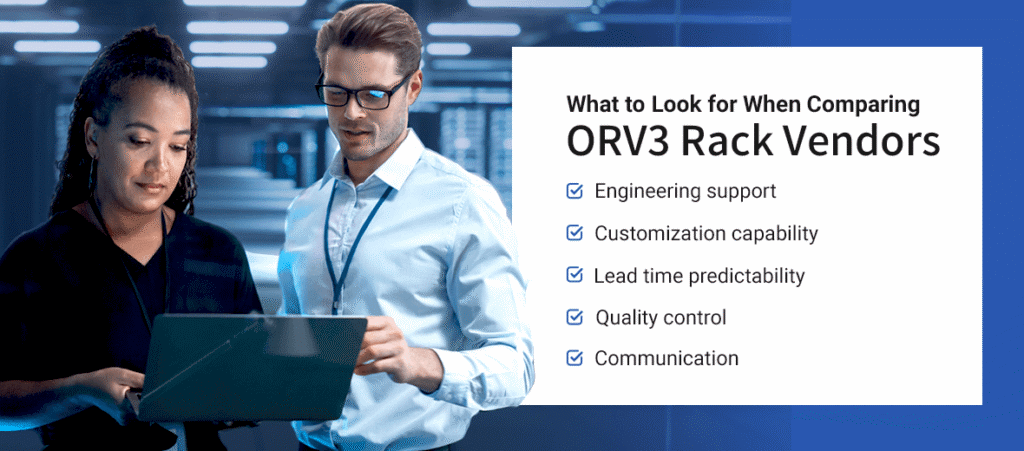
Vendor selection involves much more than compliance. Use these criteria to evaluate OCP rack suppliers on what actually matters to your deployment:
- Engineering support: The best manufacturers want to understand your application before recommending a solution. This conversation shapes everything from design to delivery.
- Customization capability: Off-the-shelf racks rarely fit complex deployments without modification. Look for manufacturers who can adapt standard designs to your specific requirements without incurring full-custom costs or lead times.
- Lead time predictability: Overseas sourcing introduces variability that’s difficult to plan around. North American manufacturing typically provides more consistent timelines.
- Quality control: Fabrication consistency varies significantly between vendors. Ask about quality certifications and whether tolerances are documented and verified across production runs.
- Communication: Some manufacturers route inquiries through automated systems. Others prioritize direct, personalized attention from people who understand your project requirements.
Common Mistakes to Avoid When Selecting a Vendor
Selecting an ORV3 rack vendor involves more than reviewing spec sheets and comparing prices. When teams focus too narrowly on compliance and cost, the factors that determine whether a deployment stays on schedule and performs as expected get overlooked.
Common mistakes include:
- Treating compliance as a performance guarantee: Building to the ORV3 spec confirms a rack meets the baseline specifications. It says nothing about how a manufacturer builds above those minimums, what modification capabilities the rack has or whether the units support additional peripherals and add-ons.
- Selecting on price alone: A rack that arrives late or requires rework on the installation floor often ends up costing more than a high-quality unit delivered on schedule.
- Ignoring lead time variability: Quoted delivery windows are estimates. Overseas sourcing makes those estimates harder to rely on.
- Waiting too long to address customization: Standard racks rarely fit complex deployments without modification. Identifying those requirements early helps prevent costly delays later.
- Leaving engineering out of the vendor evaluation: Engineers understand what the deployment actually requires. Involving them early leads to better outcomes.
Choosing the Right Manufacturing Partner Makes the Difference
Engineering depth, manufacturing precision and supply chain reliability are what separate vendors who deliver from those who simply meet product specifications. Procurement teams that weigh these factors make better decisions and avoid the problems that surface after the purchase order is signed.
Since 1975, Emcor Enclosures has been engineering enclosures for some of the most demanding applications across defense, data center and industrial markets. Every rack is designed and built in our Rochester plant in Minnesota, giving customers access to the engineering team throughout the process.
Standard ORV3-compliant racks are modified to fit your exact application requirements without the cost or lead time of a full custom build. When a standard design isn’t the right starting point, Emcor can engineer a solution from the ground up. Either way, you’re working with people who understand your application and treat your requirements as the starting place.
Discover More With Emcor Enclosures
A successful deployment starts with a real conversation about your operational needs, not a catalog with standard rack options. Our engineers are ready to discuss your specific hardware, power and thermal requirements to design a solution tailored to your application. Contact us today to get started.

Frequently Asked Questions
What Does ORV3 Compliance Actually Guarantee?
ORV3 compliance confirms internal dimensional conformance, power architecture compatibility and interface standards. It doesn’t confirm whether a manufacturer builds above those minimums, what modification capability they offer or deployment readiness.
Are All ORV3-Compliant Racks the Same?
No. Two racks can both be ORV3-compliant and perform very differently in the field. Compliance is the baseline. Engineering depth, manufacturing precision and supply chain reliability determine actual performance.
Why Does Manufacturing Location Matter for Data Center Racks?
North American manufacturing reduces lead time variability, simplifies engineering communication and limits exposure to international shipping delays and tariff changes. Problems get resolved faster and design changes don’t stall while waiting on international logistics.