Deploying ORV3 Racks at Scale
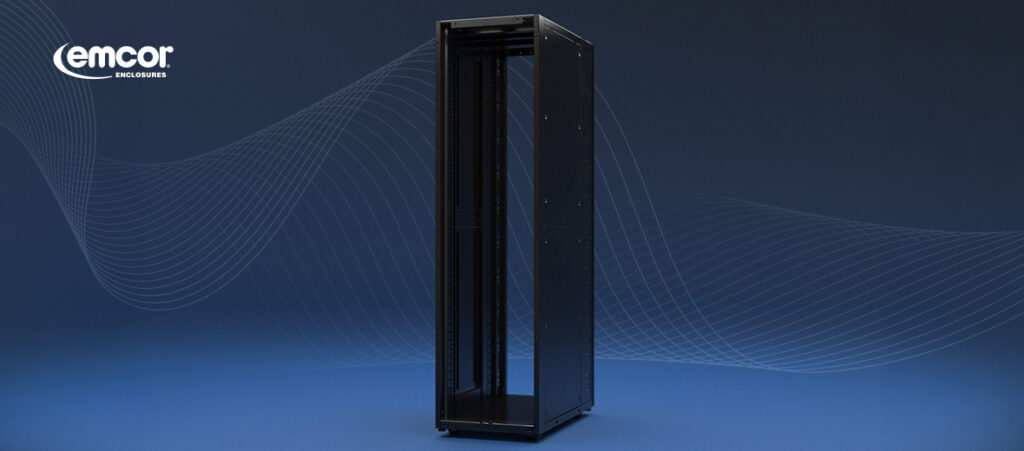
ORV3 racks follow a standardized specification, but that doesn’t mean every deployment looks the same. Deployment requirements and OCP rack use cases vary significantly across hyperscale facilities, modular data centers and edge environments.
The ORV3 specification establishes internal dimensions, power architecture and mechanical interfaces, creating a baseline architecture for rack design. What it doesn’t control is how environmental factors (such as temperature, humidity or power stability), operational constraints and deployment logistics affect rack configuration.
That’s why the specification is intentionally flexible. Going beyond the minimum means adapting a standard ORV3 design to the specific demands of your deployment — without the cost or lead time of a full custom build. A rack configured for its environment performs better, ships on time and avoids the integration problems that come from treating every deployment the same.
Why ORV3 Deployment Is Not One-Size-Fits-All
Open Rack Specification Version 3 is frequently viewed as a standardized platform that delivers consistent performance across all implementations. This perception leads to the common assumption that if a rack configuration works in one environment, it should work everywhere.
The reality is more complex. ORV3 rack deployment requirements differ substantially depending on whether you’re outfitting a hyperscale facility, a modular data center or distributed edge infrastructure.
ORV3 defines minimum power architecture, internal dimensions and mechanical interfaces, ensuring hardware compatibility across compliant racks. It does not, however, dictate external dimensions, structural reinforcement levels, accessory integration, transport durability, or environmental adaptations. These factors vary based on deployment context.
Applying a one-size-fits-all approach to your ORV3 rack deployment introduces measurable risks:
- Integration challenges arise when rack configurations don’t align with facility power distribution or cooling strategies.
- Transport and installation issues occur when structural durability doesn’t match handling conditions, is poorly toleranced externally, or has external variations that make modular build-ups difficult.
- Serviceability becomes limited if component access doesn’t reflect operational realities.
- Reliability suffers when environmental factors aren’t addressed during configuration.
The first step toward successful deployment planning is recognizing ORV3 as a flexible platform that you should adapt to its operational environment.
ORV3 Deployment Types
ORV3 racks serve multiple deployment scenarios, each with distinct operational priorities and design considerations. Understanding the differences between these deployment types helps engineers configure racks that align with infrastructure goals.
Hyperscale
Hyperscale deployments involve large-scale data center facilities where thousands of racks support high-density computing infrastructure. Due to the high quantity of identical racks needed in a hyperscale deployment, density and repeatability are key, as they enable fast rack manufacturing and rapid deployment. Consequently, standardization, operational efficiency and effective thermal management are essential aspects of the rack designs, with configurations optimized for consistent integration into controlled environments and efficient cooling at scale.
Modular
Modular deployments use pre-fabricated data center units that are assembled offsite, then transported and installed in the field. The main priorities for modular data center racks are ease of transport and structural durability.
Racks in modular environments must withstand shock, vibration and handling during shipment while maintaining alignment and integrity upon installation. The rack design addresses these needs by emphasizing structural reinforcement and shock handling capabilities.
Edge
Edge deployments place computing infrastructure in remote or distributed locations, often with limited on-site technical support. This isolation means edge data center racks must be accessible and reliable, as equipment failure can mean extended downtime if service access is difficult or replacement parts are unavailable.
Racks in edge deployments must also allow technicians to perform maintenance efficiently while protecting equipment from unauthorized access. Furthermore, these environments often house a more diverse array of equipment, potentially requiring greater flexibility in rack configuration and additional space for custom installations and power routing beyond the standard distribution bus. Due to the remote and potentially smaller facilities, the racks in edge deployments should have a compact footprint and strong security features.
Why Deployment Context Changes Rack Requirements
The ORV3 specification establishes internal dimensions to ensure hardware compatibility. Still, engineers must consider environmental factors and operational constraints when building on the baseline architecture and configuring the rack for the deployment.
A rack deployed in a hyperscale facility operates in a controlled environment with predictable power distribution, optimized airflow management and nearby technical support. The same rack specification deployed at a remote edge site faces temperature fluctuations, limited cooling infrastructure and infrequent maintenance intervals. These differences require distinct accessory selections, mounting configurations and structural adaptations.
Ignoring environmental factors during rack planning introduces operational inefficiencies and increases the likelihood of integration failures and unreliable performance.
Comparing ORV3 Deployment Requirements Across Environments
The varying operational priorities and environmental conditions of hyperscale, modular and edge deployments create distinct rack requirements. Each deployment type demands specific design considerations to ensure performance and reliability.
Hyperscale Deployment Requirements
Hyperscale facilities prioritize high-density computing, repeatable deployment across thousands of racks and operational efficiency. To accommodate these priorities, engineers should design racks in these environments with:
- Standardized configurations that minimize variation.
- Integrated 48V power distribution to support Open Compute hardware.
- Optimized airflow alignment to maintain thermal performance at scale.
A standardized design is particularly important, as even minor configuration differences compound across large deployments, creating inventory complexity, complicating maintenance and slowing installation.
Meanwhile, customization is a low priority in hyperscale rack deployment. Consistent rack designs facilitate enhanced data center rack scalability, bulk procurement and streamlined installation processes. This standardization also optimizes serviceability for efficiency rather than individual rack access, with maintenance procedures designed around predictable component locations and layouts.
Modular Data Centers Deployment Requirements
Modular environments are portable and include pre-fabricated data center units and infrastructure transported to deployment sites. Since racks in modular environments must maintain their structural integrity and alignment after transport, they must withstand shock, vibration and handling stress while fully loaded. The racks may also face installation constraints in field conditions, so easy installation is vital.
To meet these criteria, OCP modular deployment requires:
- Reinforced rack structures that prevent frame distortion and component damage during transport.
- Secure mounting systems that ensure installed hardware remains in place under vibration and shock.
- Protection during transit, which may include temporary bracing, protective panels or specialized packaging.
- Preconfigured systems that minimize field assembly and enable rapid deployment capability once the modular unit is positioned.
Serviceability is limited during transport but becomes critical once units reach their destination.
Edge Deployment Requirements
Edge environments are typically remote or distributed locations with limited on-site support and small spaces. These environments often aren’t purpose-built for deployments and could include telecom closets, retail back rooms or industrial control spaces, which is why main priorities include:
- Easy service access: Since maintenance visits will be infrequent, you should make the most of each visit by facilitating fast and accessible servicing. Organized cable management can simplify service tasks, and accessible components can allow for quick troubleshooting and part replacement.
- Strong physical security: Many edge deployments sit in unsecured or semi-secured spaces, making lockable doors and tamper-resistant panels essential additions rather than optional upgrades.
- Compact footprints: Installation and storage areas may be constrained in edge environments, often necessitating a compact rack design.
- Flexible customization: Since the site is unlikely to have been built with ORV3 deployments in mind, racks may need to be customized to address site-specific constraints. Additionally, systems must operate reliably with minimal human oversight, making proper ORV3 rack configuration and customization essential to long-term performance.
- Adaptability for upgrades: Edge racks should be designed to accommodate future component swaps and upgrades efficiently, recognizing that equipment may evolve over the deployment’s lifespan.
Accessories and Modifications for ORV3 Deployments
Through accessories and modifications that adapt racks to specific deployment needs, engineers can extend their ORV3 rack configuration beyond the base specification. Common additions include:
- Cable management systems that organize power and data connections.
- Security panels and locking doors that restrict physical access.
- Transport bracing and reinforcement to protect racks during shipment.
- Grounding enhancements that ensure electrical safety and performance across varying installation environments.
- Airflow management solutions to optimize cooling and thermal performance.
These accessories bridge the gap between the standard ORV3 specification and real-world deployment requirements. A hyperscale facility may require standardized cable management to support rapid installations across thousands of racks, while a modular deployment might need transport bracing to prevent structural damage during field delivery. An edge deployment may demand locking doors and accessible cable routing to balance security with serviceability.
In many cases, OCP rack accessories are essential rather than optional. Racks without the necessary accessories risk damage, unauthorized access and inefficient operations, which is why it’s important to understand which accessories are vital to your rack.
Designing ORV3 Rack Solutions for Specific Deployments
Successful ORV3 rack deployment requires intentional configuration rather than defaulting to standard offerings. To choose the right configuration for their racks, engineers must consider deployment type, environmental conditions and operational requirements when specifying rack solutions. Specifically, engineers must account for:
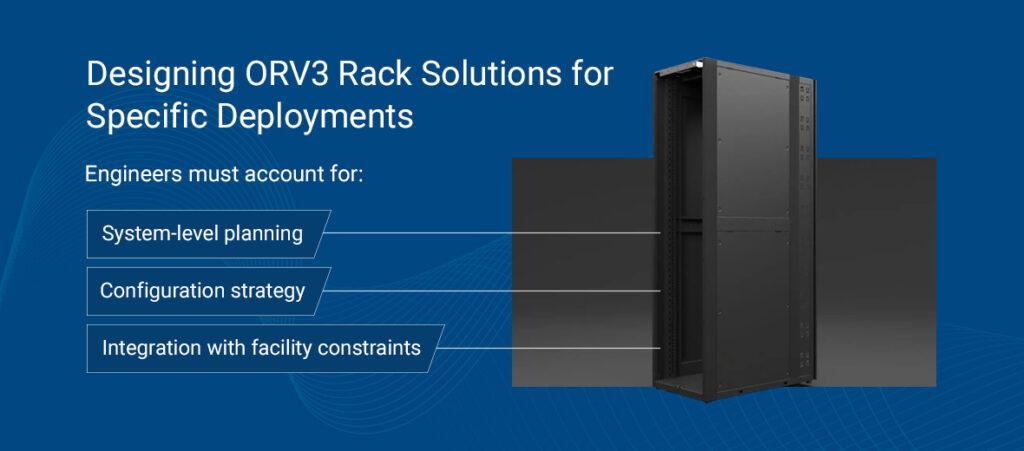
- System-level planning: Align rack design with the larger infrastructure system to ensure the rack functions as part of a cohesive whole. This alignment includes evaluating how racks integrate with facility power distribution, cooling systems and network architecture.
- Configuration strategy: Identify whether a standard or customized build best serves operational needs, budget constraints and environmental conditions. Hyperscale deployments where repeatability drives efficiency often require standardization, while customization is more valuable in edge deployments where site-specific requirements vary significantly.
- Integration with facility constraints: Assess available power capacity, cooling infrastructure and physical space in the target facility to ensure successful installation and operation.
These planning decisions made early in the procurement process can determine whether deployed racks meet performance expectations or require costly modifications after installation.
Common Mistakes in ORV3 Deployment Planning
Engineers who fail to properly plan their ORV3 rack deployment can encounter avoidable problems. Common mistakes include:
- Assuming all ORV3 deployments are identical: Treating the specification as a universal solution ignores environmental and operational differences that affect rack performance.
- Ignoring transport requirements for modular builds: Failing to account for shock and vibration during shipment can result in damaged racks or misaligned components upon installation.
- Underestimating service access needs: Edge deployments in particular require accessible components and clear cable routing to support infrequent maintenance visits.
- Failing to plan for accessories and modifications: Assuming the base ORV3 specification includes all necessary features overlooks critical additions like locking mechanisms, cable management and transport bracing.
- Delaying configuration decisions: Postponing rack specification until late in the project timeline limits customization options and increases the risk of integration issues.
- Ignoring the rack’s power architecture: While traditional data center racks typically require a 12-volt power supply, standard ORV3 racks are built around 48-volt DC power. Failure to ensure the rack’s power architecture and the available power supply are compatible can lead to performance and reliability issues.
Recognizing these pitfalls during the planning phase helps engineers avoid costly errors and ensures ORV3 racks deliver expected performance.
Why Trust Emcor Enclosures
Designing an ORV3 rack that meets your deployment’s unique needs and constraints is vital, but if your rack isn’t built to its design, it may fail to perform as expected.
At Emcor Enclosures, we partner with you to design and manufacture a rack that’s perfectly suited to your deployment. Our reliable service and exceptional products are all possible thanks to our:
- Experience: Over several decades, we’ve delivered custom racks to businesses and organizations across a wide range of industries. We provide tailored solutions that meet diverse needs without compromising on lead time or budget.
- Simple modification process: We make it easy to customize your rack so that it’s perfectly designed for your deployment.
- Quick lead time: We know that racks can sometimes be needed urgently, which is why we’re proud to offer fast design, build and shipping services.
- Competitive pricing: Our prices are always reasonable and competitive.
- Domestic manufacturing: Creating our racks here in the U.S. means we can quickly resolve problems, shorten lead times and build high-quality products.
- Helpful team: Our team is happy to help with live support.
Matching ORV3 Rack Design to Deployment Environment
Emcor Enclosures delivers ORV3 rack solutions configured for your specific deployment requirements. Our team collaborates with engineers and program managers to assess deployment type, environmental conditions and operational constraints, then configures racks that align with your infrastructure goals. Whether you’re deploying at hyperscale, outfitting a modular facility or supporting distributed edge infrastructure, we provide the exact rack solution you need.
To find out how we can design and build your perfect ORV3 rack, find a representative or request a quote today.
Frequently Asked Questions on ORV3 Rack Deployment
Engineers and program managers frequently have questions about ORV3 rack deployment as they evaluate solutions for specific environments.
Are ORV3 Racks the Same Across all Deployments?
No. While ORV3 racks follow a common specification for internal dimensions, mechanical interfaces and power architecture, they can differ significantly across deployments. Racks are tailored to specific operational needs and environmental conditions to achieve optimal performance. Hyperscale, modular and edge deployments each require distinct configurations.
What Changes Between Hyperscale and Edge Environments?
Hyperscale environments operate in large, controlled facilities with standardized infrastructure and nearby technical support. Edge environments involve remote or distributed locations with limited on-site support and variable installation conditions. These differences affect facility size, operational goals and deployment priorities. Hyperscale rack deployment prioritizes density, uniform thermal control and repeatability, while edge deployments emphasize serviceability, security and compact design.
What Accessories Are Needed for ORV3 Racks?
Common accessories include cable management systems, security panels and locking doors, transport bracing and reinforcement and grounding enhancements. Whether these accessories are necessary or simply advantageous depends on the deployment scenario. Modular deployments typically require transport bracing, while edge deployments benefit from locking mechanisms and accessible cable routing. Hyperscale facilities may prioritize standardized cable management for efficiency.