Questions AI Data Center Teams Should Ask Before Choosing High-Density Racks

AI data center conversations typically focus on GPUs, servers, cooling capacity, power availability and networking infrastructure. However, teams often overlook the rack infrastructure that allows these systems to operate efficiently and reliably. This oversight can lead to deployment delays, cooling constraints and serviceability problems, and may even lead to costly redesigns.
With compute density climbing from traditional server loads to distributed AI workloads across many servers, the rack has shifted from a mounting structure to a key component of the infrastructure system. When AI data center rack infrastructure is treated as a late-stage purchasing decision, deployment challenges grow more common and more expensive.
To avoid these challenges, data center teams should ask harder rack infrastructure questions at the design stage before scaling AI compute.
Why Rack Infrastructure Matters More in AI and High-Density Compute Environments
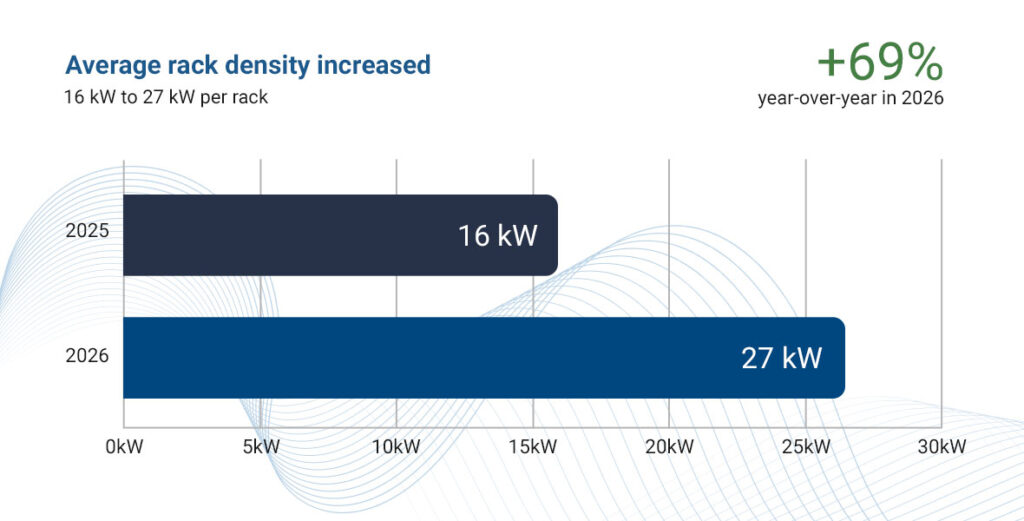
Average rack density increased 69% year-over-year in 2026, from 16 kW to 27 kW per rack. This higher rack density affects the deployment in several ways, such as:
- Higher power density: Rack design must accommodate data center rack power distribution architecture, including how power enters the rack, where distribution components mount and whether the design supports future equipment changes.
- Concentrated thermal loads: Traditional air cooling starts struggling beyond 40-50 kW per rack, but since high-density compute racks can exceed this range, thermal management remains a critical element of rack performance.
- Greater cable volume: Dense deployments generate substantial power and data cabling. Routing needs planning up front to prevent congestion and blocked airflow.
- Maintenance complexity: As equipment density climbs, technician access and routine maintenance become more complex. If not planned at the rack design stage, equipment density creates problems later.
It is more important than ever to consider racks as vital infrastructure, rather than just a mount for hardware.
7 Rack Infrastructure Questions to Ask Before Scaling AI Compute
Asking the right questions before scaling lets you specify a rack that fits your system-level requirements instead of retrofitting after deployment.
1. What Power Architecture Will the Rack Need to Support?
Power architecture decisions shape how the rack gets physically designed. This architecture determines:
- How power enters the rack.
- Where distribution components mount.
- What accessories the system needs.
- Whether the design can adapt to future equipment.
The industry is moving from 12V to 48V power delivery for high-density applications, which removes per-server power cords and changes how power is distributed inside the rack. Many racks, such as ORV3-compliant rack systems, reflect this high-density power delivery model by addressing the internal rack dimensions required for 48V busbar distribution.
2. How Will Airflow and Cooling Strategy Affect Rack Design?
AI infrastructure creates concentrated thermal loads, which makes effective thermal management vital. To successfully manage temperatures, your rack design must consider:
- Door perforation percentage.
- Airflow direction.
- Equipment spacing.
- Ventilation patterns.
- Cable routing.
- Cooling method.
Whichever cooling method your deployment uses, whether it’s air cooling, liquid cooling or direct-to-chip cooling, the rack design influences how well that cooling approach performs. Missing these details reduces cooling efficiency and constrains your ability to scale density.
Both data center containment solutions and rack-level cooling approaches require the rack design to support the intended thermal management strategy.
3. How Will Cable Pathways Be Managed at Higher Density?
Poor cable planning in dense deployments creates problems downstream. Blocked airflow cuts cooling efficiency, difficult serviceability extends maintenance windows and troubleshooting delays stretch downtime.
To avoid these problems, integrate vertical and horizontal cable managers into the rack design, while also considering:
- Power and data separation: How will power and data cabling be separated inside the rack to reduce interference and simplify troubleshooting?
- Bend radii: Does the rack design have the required bend radii for high-speed data cables and power conductors?
- Ingress and egress points: Are there enough cable entry points at the top, bottom and sides?
- Future maintenance: Can the cable management approach handle equipment swaps without requiring complete recabling?
4. What Grounding and Bonding Requirements Need to Be Addressed?
Engineers can underestimate how much rack design affects grounding performance. However, you cannot assume that power cord grounds handle everything — the rack design can affect grounding continuity, equipment safety and long-term reliability. While designing the rack’s grounding early in the process can be beneficial, it is not vital, as it can also be done throughout the maturation process.
Rack-level factors, including painted surfaces, contact point design, finish type and accessory configurations, can disrupt grounding continuity. Since grounding is a legal requirement under National Electrical Code Article 250, it is important that these factors are all considered.
Before ordering your rack, ensure your grounding specifications are incorporated into the design sent to the manufacturer.
5. Can the Rack Support Real-World Load and Installation Conditions?
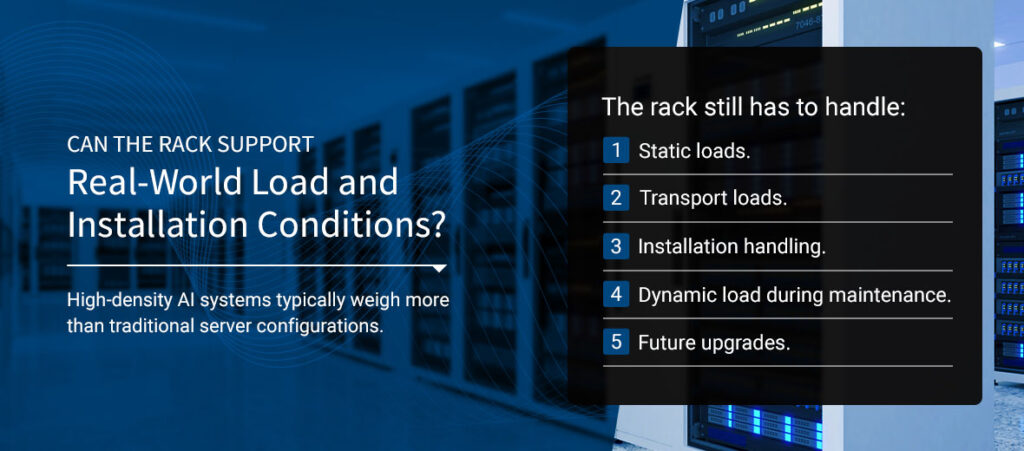
High-density AI systems typically weigh more than traditional server configurations thanks to the increased hardware demand. Despite the additional weight, the rack still has to handle:
- Static loads.
- Transport loads.
- Installation handling.
- Dynamic load during maintenance.
- Future upgrades.
Before ordering your rack, review its load capacity and frame rigidity, along with the installation and facility-specific requirements.
6. How Will Technicians Access and Service Equipment?
Maintenance planning regularly gets skipped until deployment, which can directly increase downtime. To avoid this, choose or design your rack with these factors in mind:
- Service aisle width: Does the facility layout give technicians enough space to work?
- Equipment removal: How easily can components be removed? In what direction?
- Door accessibility: Can equipment be reached through the rack door?
- Cable obstructions: Will the cable configuration block access to equipment needing regular maintenance?
- Scalability: When the deployment scales, will maintenance workflows stay repeatable?
Rack specifications that, like ORV3, use a front-access design philosophy put maintenance ease up front.
7. Will the Deployment Use Traditional Racks, OCP ORV3, or a Hybrid Environment?
Not every data center will use OCP ORV3 racks, with some preferring traditional 19-inch racks. Some deployments may use a mixture of racks. Whatever the scenario, it is important to know which racks your data center will use, as this information can affect your planning requirements for:
- Dimensions.
- Mounting.
- Power distribution.
- Service access.
- Equipment compatibility.
How OCP ORV3 Is Changing Rack Planning Expectations
As AI data centers scale to high-density compute, rack infrastructure becomes increasingly important. OCP ORV3 rack infrastructure regularly reflects this importance, demonstrating how rack architecture is connecting more closely with system-level infrastructure planning.
While some types of racks may not be designed with the wider data center in mind, OCP ORV3 racks are designed with improved integration. Features include:
- 48V power delivery: Moving from the traditional 12V delivery to 48V allows for thinner cabling, as current is reduced. Less space is required for cabling. The higher voltage also minimizes power loss and delivers a more stable power supply.
- Busbar architecture: This design replaces bulky cable harnesses with a more efficient system that facilitates hot-swappable components, simplifies power management and improves fault tolerance.
- Modular equipment access: Engineers must consider the ORV3 rack’s front access design, as it will affect how technicians reach the hardware within the rack.
- Dimensions: ORV3 racks are often wider than the standard 19-inch racks, meaning engineers must account for their larger size.
- Serviceability: Besides making the hardware easy to access, ORV3 racks increase operational ease through clear pathways for hot-swapping power supplies and storage, tool-less maintenance features, and cabling that enhances air flow.
To properly account for these features, engineers should align the rack’s infrastructure with the data center’s power, thermal and deployment strategy. Teams that are not fully adopting ORV3 can still learn from how the rack infrastructure is designed as part of a larger whole, rather than as an isolated component.
Common Problems When Rack Infrastructure Is Treated as an Afterthought
When rack infrastructure is not reviewed early, your deployment is more likely to experience:
- Power distribution constraints: Even if your equipment fits physically, you may limit power access or future scalability because the distribution architecture was not considered during rack selection.
- Cooling performance restrictions: Cable congestion, poor rack layout or inadequate ventilation can interfere with cooling plans and reduce efficiency.
- Serviceability issues: Technicians may struggle to access equipment, replace components or perform routine maintenance if these workflows were not considered during the design phase.
- Integration delays: Racks may require field modifications when mounting, spacing, cable pathways or accessories aren’t planned early enough.
- Limited scalability: A rack may work for the first deployment, but without advanced planning, it may not support future equipment changes or higher densities.
Benefits of Better Rack Planning
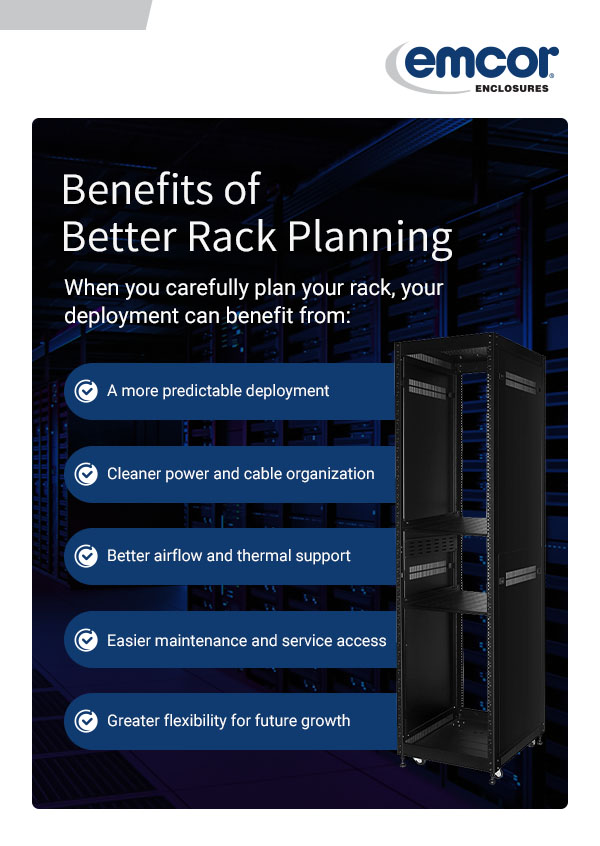
When you carefully plan your rack, your deployment can benefit from:
- A more predictable deployment: Comprehensive and detailed rack planning leads to a seamless and timely deployment.
- Cleaner power and cable organization: When you know what cables and power supply your rack must support, you can design a rack that neatly accommodates them.
- Better airflow and thermal support: A thoughtfully designed rack can enhance airflow and provide stronger thermal support to the hardware it houses.
- Easier maintenance and service access: When a rack is designed with maintenance in mind, technicians can more easily access the hardware, leading to more efficient maintenance and reduced downtime.
- Greater flexibility for future growth: Custom or semi-custom rack planning can support changing equipment, density, and deployment requirements.
Planning leads to a rack that better supports your AI data center’s servers, GPUs and other equipment.
When Custom or Semi-Custom Rack Infrastructure May Be Needed
Standardized rack designs work for many deployments, but there are certain conditions that may require custom or semi-custom infrastructure, including:
- Non-standard equipment dimensions
- Specialized cooling integration
- Site-specific power configurations
- Unique grounding needs
- Facility constraints
A manufacturer that offers customization can start with a standardized design, then modify it to fit specific requirements. This approach can create specialized cable pathways, airflow patterns and mounting configurations without the cost and lead time of building from scratch. By balancing standardization with flexibility, data center enclosure infrastructure can perform to the required standards without unnecessary complexity.
AI Data Center Rack Planning Checklist
An effective way to design the rack that meets your deployment’s needs is to use a planning checklist. Before finalizing the rack specifications, ensure you know the answers to these questions:
- What power architecture will the rack need to support?
- Will the deployment use traditional rack power, 48V power delivery, busbars or a hybrid approach?
- What cooling methods will the rack use?
- Will cable routing interfere with cooling, access or maintenance?
- Are grounding and bonding requirements understood?
- Can the rack support the expected static and dynamic loads?
- How will technicians access and service the equipment?
- Are installation, leveling, movement and facility constraints accounted for?
- Will the rack support future equipment changes or density increases?
- Is a standard rack sufficient, or does the application require custom or semi-custom infrastructure?
- Are OCP ORV3 requirements relevant to this deployment?
- Has the rack infrastructure been evaluated early enough in the design process?
Why Emcor Enclosures Is Your Trusted Rack Infrastructure Partner
At Emcor, we know how important rack infrastructure is for AI data centers with high-density compute. With customization at the heart of our service, our ORV3 planning can include 48V power delivery, busbar architecture and modular equipment access. Additionally, our modular sheet metal construction allows customization without the cost of building one from scratch.
Beyond our customization abilities, our experience allows us to stand out from our competitors. We have manufactured racks for demanding applications, from defense contractors and national labs to system integrators and data center operators, for decades.
To help you decide whether the rack we designed for you meets your needs, we include STEP files as part of our configure-to-order process, so you can test before committing.
Whether you are specifying ORV3-compliant rack systems or custom enclosures for high-density compute, we work with you to design infrastructure that fits your system-level requirements.
Discuss Your AI Data Center Rack Infrastructure Requirements With Emcor Enclosures
At Emcor, we work with data center teams to design ORV3-compliant racks and custom enclosures built for high-density deployments. No matter your specifications, facility constraints and deployment requirements, we will be your partner in designing the right enclosure for your needs.
If you are planning an AI infrastructure deployment or reviewing rack requirements for OCP, ORV3, or high-density data center environments, we are ready to work with you on a design that fits your system-level needs.
To discuss your custom data center rack requirements, find a representative today.