OCP vs. Traditional Server Racks: What Engineers Need to Know Before Upgrading

Traditional EIA-310 racks provide universal hardware compatibility and lower entry costs, whereas Open Compute Project (OCP) designs utilize shared busbar power and front-access maintenance to maximize hyperscale efficiency. While OCP offers superior ROI for high-density environments through improved airflow and modularity, traditional racks remain the standard for smaller operations and legacy infrastructure.
For decades, EIA-310 racks have been the industry standard in server rooms and data centers worldwide. Today, Open Compute Project (OCP) designs are gaining popularity, offering improved efficiency, enhanced airflow and lower operating costs for a range of applications. Engineers considering an upgrade must determine whether OCP is beneficial for their specific needs.
The answer to upgrading depends on facility and operational priorities. EIA-310 racks are universally compatible with many different types and brands of networking equipment. OCP racks are designed for high-density environments where improved airflow and centralized power distribution can reduce energy and cooling costs.
This guide breaks down the key differences, allowing you to evaluate which design is the right fit for your requirements.
What Defines a Traditional EIA-310 Rack
Most EIA-310 racks feature a 19 inch (483 millimeter) width with standardized mounting holes spaced at uniform intervals, allowing users to change out equipment freely. Depth typically ranges from 24 to 42 in (610 to 1067 mm), depending on the intended purpose. These units are popular for a range of applications, from telecom facilities and industrial control rooms to test labs and research facilities.
Key features include:
- Equipment compatibility: Nearly any rackmount hardware fits without modification or adapters.
- Parts availability: Dozens of manufacturers make compatible components, keeping costs competitive.
- No learning curve: Maintenance teams already know how to work with the industry standard.
- Lower up-front cost: Mature competition keeps prices reasonable for most budgets.
The downside? EIA-310 wasn’t designed for modern thermal and power demands. Airflow management often requires blanking panels, containment systems and related components. Power distribution still relies on individual power distribution units (PDUs) mounted in each rack, resulting in cable spaghetti and limited flexibility. As server densities increase, these limitations become increasingly challenging to overcome.
What Makes OCP Different?
OCP emerged from large-scale data center operators who needed infrastructure that could scale efficiently across thousands of racks. Rather than adapting existing standards, they created the OCP design from scratch, focusing on energy efficiency, modularity and simplified maintenance. The Open Compute Project Foundation then took these initial OCP designs and made them publicly available as open standards. This approach enabled different companies to collaborate on defining and refining the exact technical specifications.
OCP racks offer a 21 in (533 mm) interior width, rather than the traditional 19 inches, which provides additional space for airflow channels and cable management.
Key features include:
- Improved airflow: Front-to-rear cooling paths with wider channels reduce turbulence and improve thermal management.
- Toolless installation: Components slide and lock into place without screws or cages, speeding deployment and reducing hardware costs.
- Front-access maintenance: Technicians can service equipment without navigating cramped hot aisles or moving adjacent racks.
- Shared power distribution: High-capacity busbars replace individual PDUs, simplifying cable runs and improving load balancing.
The open-standard approach means more flexibility in component selection, but fewer preconfigured options compared to the EIA-310.
Side-by-Side Comparison of OCP vs. EIA-310
| Feature | Traditional EIA-310 | OCP Rack |
| Form Factor | 19 in (483 mm equipment width, fixed height | 21 in (533 mm) equipment width, modular height |
| Cooling | Passive or forced air | Front-to-rear airflow with hot/cold aisle optimization |
| Power Distribution | Individual PDU per rack | Shared busbar power for reduced cabling |
| Maintenance Access | Often requires rear access for power/cabling | Front access for easy servicing |
| Cost and Ecosystem | Lower entry cost, broad ecosystem | Higher initial cost, long-term efficiency |
| Use cases | Broad enterprise and SMB | Hyperscale and efficiency-focused data centers |
Selecting the Right Rack for Your Needs
The best choice between traditional and OCP racks depends on your facility’s specific requirements, existing infrastructure and long-term operational goals. Both systems offer advantages that make them ideal for different situations.
When Traditional EIA-310 Racks Make Sense
Traditional racks are still highly effective for many legacy systems, especially when using different types of hardware is a higher priority over increased efficiency. Facilities with established EIA-310 infrastructure can continue adding compatible hardware without costly retrofits. Additionally, their lower entry cost might make them more practical for some smaller operations or projects with budget constraints.
Low-density environments typically don’t benefit significantly from OCP’s efficiency improvements, so the additional cost usually isn’t justifiable when cooling and power are not major concerns. Some facilities with existing EIA-based infrastructure face high switching costs that may never pay back through operational savings.
When OCP Is the Better Choice
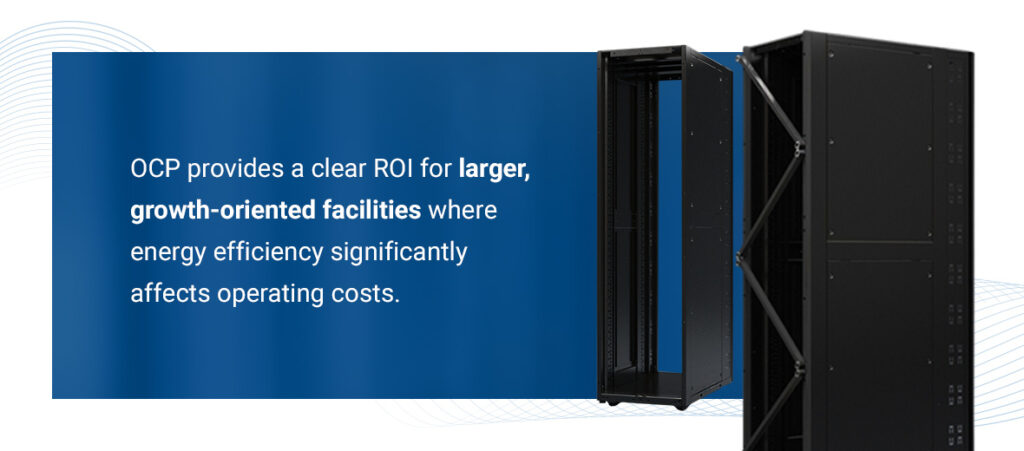
OCP provides a clear ROI for larger, growth-oriented facilities where energy efficiency significantly affects operating costs. Hyperscale data centers see measurable savings in cooling and power distribution. Plus, the front-access design reduces service time in high-density environments.
High-density server applications generate enough heat that improved airflow and power distribution deliver measurable savings within the first few years of implementation. Facilities planning frequent hardware upgrades benefit from toolless maintenance and front-access servicing, which reduces labor costs and minimizes downtime.
Hybrid Configurations
Hybrid configurations can often be a practical middle ground. Engineers can implement OCP cooling principles in modified EIA-310 racks, gaining efficiency benefits without completely abandoning the existing infrastructure. Modular power distribution systems adapted from OCP designs work in traditional rack widths, simplifying cable management. This approach enables organizations to modernize incrementally and spread out costs rather than committing to an entire rebuild.
However, migration planning is critical. Switching standards mid-deployment creates compatibility challenges that can offset gains in efficiency. Hybrid systems are where expert engineering consultation is highly beneficial, as it helps teams evaluate whether OCP makes sense for their specific application or if a modified traditional design delivers better value.
Planning Your Migration
Switching from EIA-310 to OCP infrastructure involves more than just swapping racks. Engineers frequently encounter challenges like:
- Physical space adjustments: Differences in rack footprint and rail geometry between traditional and OCP/Open Rack designs can affect floor layout, aisle spacing and seismic bracing calculations.
- Infrastructure compatibility: Existing power and network cabling may not reach new rack positions, requiring costly extensions or redesigns.
- Airflow disruption: Changes to rack geometry and airflow zoning can require updates to existing hot-aisle and cold-aisle containment strategies.
- Workflow changes: Maintenance teams may need retraining for front-access procedures and toolless component handling.
Careful planning and accurate budgeting help prevent these factors from affecting the overall success of your project.
Why Trust Emcor Enclosures?
Emcor Enclosures has been a leader in the industry for decades, delivering enclosures engineered for all types of environments, from aerospace and defense to industrial and telecommunication. Our manufacturing is done entirely in the United States, with lead times that accommodate rapid prototyping and full production runs. When standard catalog products don’t fit your requirements, our engineering team can develop a customized solution, whether adapting OCP specifications to existing infrastructure or designing hybrid systems that bridge the gap between both designs.
We prioritize personalized attention in everything we do, regardless of the size or scope of your operation. From initial consultation and design through delivery and integration services, our team provides the technical support and follow-through that every project needs to succeed. Fast turnaround times and competitive pricing mean your project stays on schedule and on budget.

Contact Emcor Today to Get Started
Are you still unsure whether an OCP or a hybrid approach is the best fit for your facility? Our engineers can evaluate your specific requirements and recommend the most practical and cost-effective solution. Contact us today to schedule a consultation or download our OCP planning guide to learn more about our capabilities.